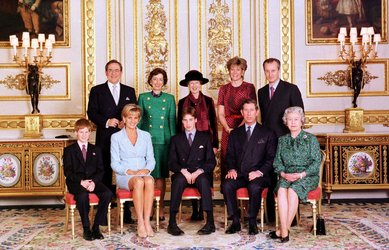
About House of Windsor
Historically, members of Royal families had no need for 'surnames', as Kings and princes were  known by the names of the countries over which they and their families ruled. Kings and queens  therefore signed themselves by their first names only, a tradition in the United Kingdom which has  continued to the present day (see style and title).

Members of the British Royal family had no surname before 1917, but only the name of the  dynasty to which they belonged.   The names of dynasties tended to change when the line of  succession was taken by a rival faction within the family (e.g. Henry IV and the Lancastrians,  Edward IV and the Yorkists, Henry VII and the Tudors), or when succession passed to a different  family branch through females (e.g. Henry II and the Angevins, James I and the Stuarts,  George I and the Hanoverians).

Just as children can take their surnames from their father, so sovereigns normally take the  name of their 'House' from their father. For this reason, Queen Victoria's eldest son Edward VII  belonged to the House of Saxe-Coburg-Gotha (the family name of his father Prince Albert). Edward  VII's son George V became the second king of that dynasty when he succeeded to the throne in 1910.
|

LOADING! Please wait ...
Getting Around
There are several ways to browse the family tree. The Tree View graphically shows the relationship of selected person to their kin. The Family View shows the person you have selected in the center, with his/her photo on the left and notes on the right. Above are the father and mother and below are the children. The Ancestor Chart shows the person you have selected in the left, with the photograph above and children below. On the right are the parents, grandparents and great-grandparents. The Descendant Chart shows the person you have selected in the left, with the photograph and parents below. On the right are the children, grandchildren and great-grandchildren. Do you know who your second cousins are? Try the Kinship Relationships Tool. Your site can generate various Reports for each name in your family tree. You can select a name from the list on the top-right menu bar.
In addition to the charts and reports you have Photo Albums, the Events list and the Relationships tool. Family photographs are organized in the Photo Index. Each Album's photographs are accompanied by a caption. To enlarge a photograph just click on it. Keep up with the family birthdays and anniversaries in the Events list. Birthdays and Anniversaries of living persons are listed by month. Want to know how you are related to anybody ? Check out the Relationships tool. |
|
|
|